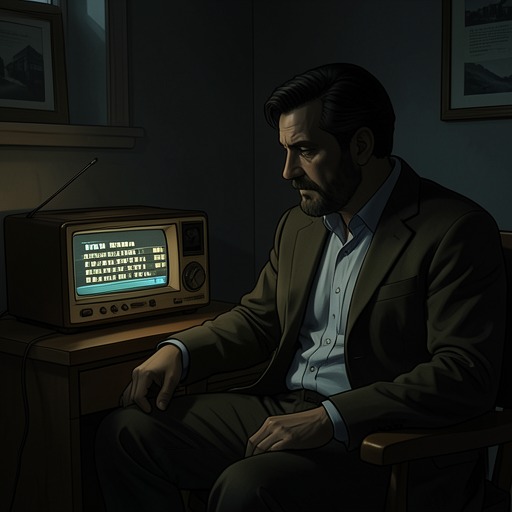
Portable Radio
The Box ManThe Portable Radio carries two opposed meanings in the box man’s account: it once kept the narrator compulsively attached to a ceaseless stream of news, but later became an object he could relinquish and a possible comfort for someone beginning life in a box. Its movement between possession, discarded burden, and proposed gift gives a practical device an unusually clear place in the narrator’s story of dependence and separation.
A Necessary Possession, Then a Burden
When the narrator describes the equipment and clutter accumulated during his first period living in a box, he recalls that he once kept things indiscriminately, saving objects because they might someday prove useful. That earlier habit made his possessions multiply until cramped quarters and their weight forced him to reconsider what a box man actually needed. A small, well-sounding portable FM radio stands out as a difficult test of that decision: it was familiar and useful, yet the narrator asks whether anyone who habitually used one could really dismiss it as trash merely to lighten a load. He says he was able to do even that. The radio is therefore not just one item in a list; it marks the point at which practical life demands that attachment be weighed against carrying capacity.
The narrator’s working rule for possessions is severe: an item that is not used at least three times a day should be discarded. But the radio complicates any clean distinction between indispensable equipment and waste. He acknowledges that storing objects takes effort, while throwing them away takes still more, and that having possessions can leave a person anxious about losing them. The radio’s attraction is not erased by the decision to part with it. Rather, its former usefulness and emotional pull make the act of letting it go significant.
News Addiction and the Radio’s Reach
The radio belonged to a larger apparatus of news consumption. Before his dependence eased, the narrator read seven newspapers, kept two television sets and three radios in his room, carried a portable radio when he went out, and slept with earphones plugged in. Reports from different stations could arrive at once, and special broadcasts might interrupt at any time. This accumulation made continuous access to news seem essential: events across the world appeared to change from minute to minute, and the narrator feared that looking away even briefly might mean missing another change.
Yet the narrator distinguishes the form of news from truth and lived experience. He recognizes that searching through reports did not necessarily bring him closer to the truth, but says he could not stop. What he may have needed, he reflects, was news in its compressed, familiar form rather than direct knowledge. The Portable Radio thus offered not simply information but an ongoing format of attention: it let the listener keep checking that the world was still producing reports. Its reach extended from the narrator’s room to his outings and even into sleep, narrowing the space in which he could be apart from the news.
The account of how this dependence suddenly ended is deliberately modest. On a sidewalk, a middle-aged passerby collapsed and remained motionless. A young man who noticed him went to use a nearby telephone; the narrator, then working occasionally as a commercial photographer, considered photographing the scene from several angles but did not. His decisive thought was not that the death would become important news, but that it would never become news at all. The trivial incident served as an antidote to his addiction. In the structure of the recollection, the radio’s hold is broken not by a more authoritative report or a better source, but by the narrator’s recognition that reality does not have to enter the news cycle to exist.
From Personal History to a Parting Gift
Later, while addressing the hospital girl and the doctor, the narrator says he wants to explain the radio so they can understand what sort of person they are dealing with. He describes the former scale of his news habit before discussing its limits, making the device a route into his past rather than merely an item offered for inspection. The account connects a concrete possession to a history of attention that might otherwise remain invisible: the radios, newspapers, and television sets had organized his days around the expectation of the next report.
The narrator also proposes leaving a miniature radio for a new box man. He presents it as useful during the first period of adjustment, when a person may be overwhelmed by loneliness. The offer is pointed because the narrator has described his own susceptibility to news addiction: the small radio is not recommended as an unquestioned necessity or as a cure, but as an interim support for someone entering an unfamiliar way of life. The same kind of object that once helped keep the narrator tethered to constant updates could, in reduced form, serve another person through an initial period of isolation.
This proposed gift belongs to a wider practical handover. The narrator describes the equipment and daily-use items shaped by experience in a box, distinguishing a functional living set from the miscellaneous objects he once accumulated. He offers these provisions without presenting them as a debt or a grand inheritance. The miniature radio has a particular place within that exchange: unlike tools whose uses are immediate and plainly practical, its value is tied to the loneliness that may accompany box life and to the narrator’s knowledge of what it means to be unable to disconnect.
The Device’s Changing Significance
The Portable Radio’s significance rests on this reversal. At first, portability makes the news habit more comprehensive: the radio can be carried outside and its listening can continue at bedtime. Later, portability belongs to the problem of a mobile life in which every possession must justify the space and effort it requires. Finally, a miniature set is imagined as a temporary companion for a newcomer. Across these uses, the device does not have one fixed meaning. Its role depends on the listener’s circumstances and on whether connection to the outside world has become compulsion, unnecessary weight, or consolation.
The account also places limits on what the radio can provide. The narrator’s access to more broadcasts did not guarantee access to truth, and the event that ended his addiction was one he judged unnewsworthy. Against the apparent promise of constant information, the radio’s story turns on what falls outside the stream of reports. Its departure from the narrator’s possessions does not erase that earlier dependence; his detailed recollection preserves it, even as his proposed gift converts the device into a modest, conditional provision for someone else.